
H-01
Whole-System Diagnostics
Remote triage and comprehensive workshop inspection use fault codes, runtime logs and observed symptoms to distinguish mechanical, electrical, sensor and software faults.
HUMANOID ROBOT / REPAIR & CALIBRATION
Hardware Repair / Motion Calibration / Lifecycle Support
Diagnostics, core hardware repair, firmware recovery and motion calibration for enterprises, universities, laboratories and public-sector projects, with annual maintenance and on-site technical support.
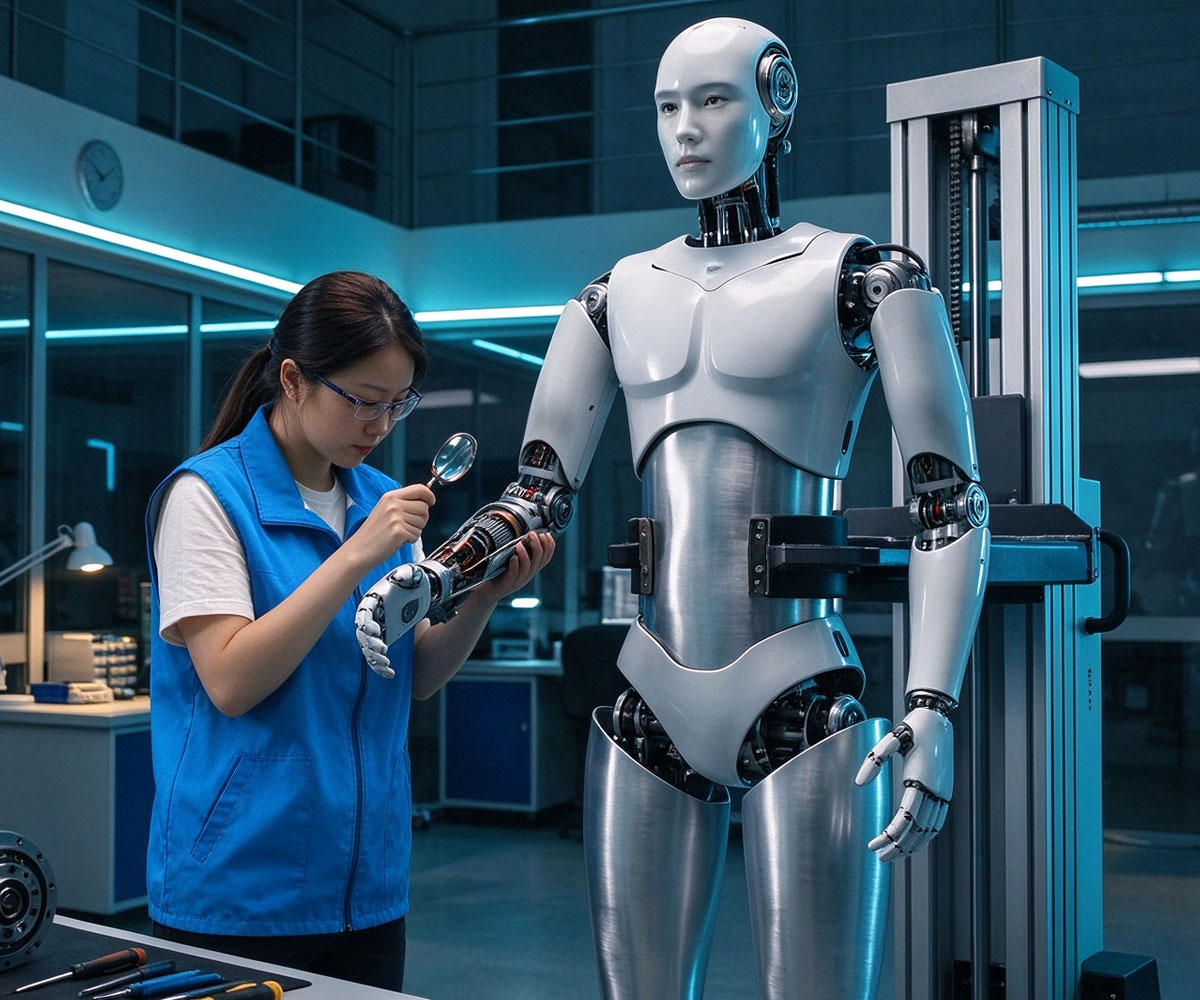
[ 01 / DIAGNOSTICS & HARDWARE ]
From complete systems to circuit boards, isolate faults and restore core electromechanical functions
Remote triage and comprehensive workshop inspection use fault codes, runtime logs and observed symptoms to distinguish mechanical, electrical, sensor and software faults.
Inspect and repair or replace joint motors, harmonic reducers, main controllers, battery packs, IMUs, LiDAR, vision cameras, communication modules and wiring harnesses based on assessment.
Address fall damage, cracked shells and jammed joints through transmission alignment and moisture-protection treatment. Verify assembly without changing the original protection rating.
Diagnose main, driver and power boards for supply, communication and drive faults. Perform re-soldering, component replacement and electrical verification where board conditions permit.
Supported models, parts sourcing, turnaround and warranty scope are determined by assessment and the agreed service plan.
02 / FIRMWARE & MOTION
Firmware, joint and whole-body dynamics tuning are essential to restoring stable humanoid robot operation.
Firmware flashing, system reinstallation, crash recovery and emergency-stop troubleshooting preserve and verify safety protections without bypassing the stop mechanism.
Perform joint-zero, gait-parameter and whole-body dynamics calibration, verifying motion consistency for the equipment structure and controller version.
Integrate interfaces with the existing embodied intelligence system, debug motion scripts and reproduce baseline functions. Model training or new feature development is outside scope unless agreed.
Calibration and functional verification follow model-specific procedures using safety fixtures and controlled spaces. System flashing, development interfaces and motion scripts require customer authorization.
[ 03 / LIFECYCLE SUPPORT ]
Routine care, annual maintenance and field support tailored to usage and delivery needs
Schedule inspections around usage, including cleaning, connection checks, wear-part replacement and key component health assessment.
Create maintenance plans for enterprises, universities and laboratories with agreed inspection intervals, repair scope, parts arrangements and response procedures.
Provide on-site technical support for public-sector projects, demonstrations and exhibitions, including pre-operation checks, troubleshooting and motion verification.
Scheduled on-site visits, protective shipping and coordinated urgent repairs are available. Complex board-level repairs or calibration may require workshop service after assessment.
[ SERVICE WORKFLOW ]
Assess and agree on a plan before repair, then deliver against agreed functional acceptance criteria
Collect model details, symptoms, logs and images; confirm equipment safety and delivery arrangements.
Identify faults and agree on repair scope, parts, pricing and estimated turnaround before proceeding.
Repair hardware, recover firmware and calibrate as needed, documenting repairs and parameter changes.
Verify agreed functions in controlled conditions, deliver inspection records and care advice, and provide contractual warranty follow-up.
[ SERVICE NOTES & FAQ ]
Clear compatibility, tuning scope and delivery requirements
Stop operation and disconnect power after falls, overheating, uncontrolled joints or battery damage. Confirm carrier requirements before transporting damaged batteries.
Agree on backups for programs, motion scripts and data before recovery. Confidentiality terms are available for research data; flashing and parameter changes require authorization.
Provide the brand, model, hardware revision and symptoms. Engineers confirm support based on parts, documentation and tuning interfaces; diagnostic and calibration requirements vary by model.
Joint, motor, reducer or sensor replacement and controller parameter changes generally require related calibration. Scope follows model procedures and assessment, with controlled verification.
On-site and shipped repairs, urgent service and resident project support can be arranged. Response and delivery times depend on location, fault complexity, parts and fixtures.
The service plan defines repaired areas, replacement parts, warranty duration and exclusions. Software work covers authorized recovery, motion tuning and agreed baseline functions, not model training or new features by default.
[ REPAIR REQUEST ]
Describe your equipment and symptoms for an engineering assessment